
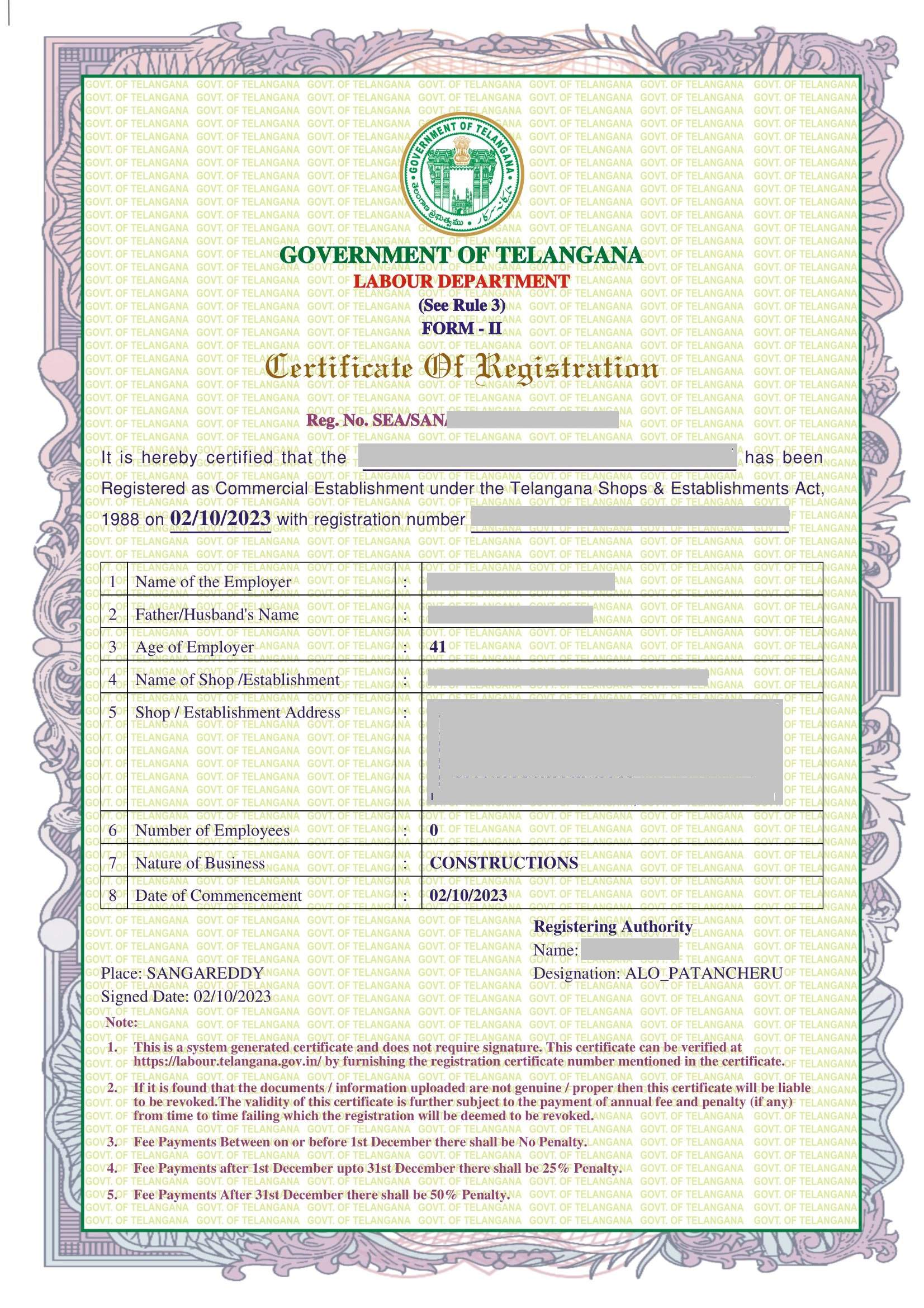
Sole Proprietorship Firm
₹2,000.00 Original price was: ₹2,000.00.₹1,300.00Current price is: ₹1,300.00.
Looking for Sole Proprietorship Firm Registration in Hyderabad? Invention Tax Solutions provides quick, reliable, and affordable registration with GST, MSME & Trade License support.
Proprietorship Firm Registration in Hyderabad: Complete Guide
Proprietorship firm registration in Hyderabad is the process of establishing and legally documenting a business owned and controlled by one individual. Unlike a private limited company, a proprietorship does not have a separate legal identity. The proprietor and business are legally treated as the same person. The business is usually established through registrations such as GST, Udyam, Shop and Establishment, or other applicable licences.
Many entrepreneurs searching for proprietorship firm registration in Hyderabad are actually looking for a simple way to start a business, open a current account, obtain GST registration, receive payments, issue invoices, or operate under a business name.
A sole proprietorship is often the most straightforward business structure for a single owner. It is suitable for many small traders, consultants, freelancers, retailers, wholesalers, home-based businesses, service providers, and individual entrepreneurs.
However, one important point should be understood clearly: there is generally no separate incorporation certificate issued for a proprietorship in the same way that the Ministry of Corporate Affairs incorporates a private limited company or LLP. Instead, the business identity is established through appropriate government registrations and licences based on the nature of the business.
Who Should Choose Proprietorship?
A proprietorship may be suitable when one person:
- Owns and controls the entire business.
- Wants a simple business structure.
- Wants to start operations quickly.
- Wants lower initial compliance costs.
- Does not require multiple shareholders or partners.
- Is testing a new business idea.
- Runs a small retail or trading business.
- Provides professional or consulting services.
- Operates a home-based business.
- Wants to receive business payments through a current account.
For example, a consultant operating from Gachibowli, a retailer in Kukatpally, a digital marketing professional in Madhapur, or a trader supplying goods across Telangana may consider a proprietorship structure.
Proprietorship Versus Company
A common search query is single owner company registration in Hyderabad. However, a proprietorship and a company are not the same legal structure.
A proprietorship is owned by one individual but does not create a separate legal person. A company, such as a One Person Company or Private Limited Company, is incorporated under the Companies Act and has a separate legal identity.
| Feature | Proprietorship | OPC / Private Limited Company |
|---|---|---|
| Ownership | One individual | One or more members |
| Separate legal identity | No | Yes |
| Incorporation with MCA | No | Yes |
| Compliance | Generally lower | Higher |
| Liability | Unlimited | Generally limited |
| Setup complexity | Simple | More structured |
| Suitable for | Small businesses | Businesses seeking formal corporate structure |
Therefore, if your primary requirement is single owner company registration in Hyderabad, you should first determine whether you actually need a proprietorship, One Person Company, or Private Limited Company.
A CA or business registration expert can help you select the appropriate structure before you spend money on registrations that may not suit your business.
Key Benefits Of Proprietorship
A proprietorship is popular because it combines operational simplicity with direct ownership.
Main Advantages
- Simple ownership: One person owns and controls the business.
- Quick setup: There is no lengthy company incorporation process.
- Lower compliance burden: Annual corporate filings are generally not required as they are for companies.
- Direct control: The proprietor makes all business decisions.
- Flexible operations: The business can be started with relatively low administrative complexity.
- Easy taxation structure: Business income is generally reported in the proprietor’s individual income-tax return.
- Suitable for small businesses: It works well for many traders, professionals, and service providers.
- Easy transition: The business can later be reorganised into an LLP, OPC, or private limited company as it grows.
The government’s Startup India guidance also describes sole proprietorships as businesses owned and managed by a single person, while noting that a proprietorship does not have a separate legal existence.
Proprietorship Registration Eligibility
Who Can Apply?
Generally, an individual who wants to conduct business in India can operate as a sole proprietor, subject to the applicable laws and licences for the business activity.
The applicant should generally have:
- A valid Aadhaar card.
- PAN card.
- Business address.
- Proposed business name.
- Details of business activity.
- Bank account details where required.
- Relevant licences based on the business activity.
The exact registration requirements depend on the nature of the business.
For example, a food business may need an FSSAI licence. A business with employees may need labour-related registrations. A business exceeding applicable GST thresholds may require GST registration. A manufacturing unit may need additional approvals.
Required Documents For Registration
The documents required depend on the registrations being obtained. Common documents include:
- Proprietor’s PAN card.
- Proprietor’s Aadhaar card.
- Passport-size photograph, where required.
- Mobile number and email address.
- Business address proof.
- Rental agreement, if the premises are rented.
- Electricity bill or utility bill.
- Ownership proof, where applicable.
- Landlord’s NOC, where required.
- Bank account details.
- Business activity details.
- Digital signature, where required for specific applications.
- Existing licence or registration details, if applicable.
A frequent mistake is assuming that every proprietorship requires the same certificate. The correct documents depend on whether you need GST registration, Udyam Registration, a local establishment registration, FSSAI, IEC, or another sector-specific approval.
Step-By-Step Registration Process
The practical process usually involves selecting the appropriate registrations for the proposed business.
Step 1: Choose The Business Name
Select a suitable business name for invoices, quotations, branding, and registrations.
A proprietorship name does not generally receive the same name reservation protection as a company incorporated through the MCA. Therefore, entrepreneurs should also consider trademark availability before investing heavily in branding.
Step 2: Finalise The Business Activity
Clearly identify whether the business involves:
- Trading.
- Manufacturing.
- Consulting.
- Professional services.
- E-commerce.
- Food operations.
- Import and export.
- Digital services.
- Construction.
- Retail.
- Wholesale distribution.
The business activity determines which registrations and licences may apply.
Step 3: Arrange Business Address Proof
The business address may be a commercial office, shop, factory, rented premises, or in some cases a residential premises, depending on the activity and applicable rules.
The documentation should be consistent across applications.
Step 4: Obtain Applicable Registration
Depending on the business, the proprietor may apply for one or more of the following:
- GST Registration.
- Udyam Registration.
- Shop and Establishment registration.
- Trade licence.
- FSSAI licence.
- Import Export Code.
- Professional Tax registration, where applicable.
- Labour-related registrations.
- Sector-specific licences.
Step 5: Open A Business Bank Account
Once the proprietor has suitable business documentation, the bank may request proof of business existence, identity documents, address proof, and other KYC documents.
Banks have their own account-opening requirements. Therefore, entrepreneurs should confirm the current account documentation requirements with the selected bank.
Step 6: Begin Compliance
After registration, the proprietor must maintain appropriate records and comply with applicable tax and regulatory requirements.
This may include:
- GST returns.
- Income-tax return filing.
- TDS compliance.
- Accounting records.
- FSSAI compliance.
- Labour compliance.
- Invoice requirements.
- Annual or periodic licence renewals.
GST And Proprietorship
GST registration is not automatically required merely because a business is a proprietorship.
GST registration depends on factors such as turnover, nature of supply, location, inter-state transactions, e-commerce activities, and other conditions under the GST law.
A proprietor may require GST registration when the applicable legal conditions are satisfied. Some businesses may voluntarily register to issue GST invoices or improve business credibility.
When GST Helps
GST registration may be particularly useful for businesses that:
- Sell to GST-registered businesses.
- Supply goods or services across states.
- Work with corporate customers.
- Need input tax credit eligibility.
- Participate in certain marketplaces.
- Want to issue GST tax invoices.
However, registering for GST without understanding the ongoing filing obligations can create unnecessary compliance responsibilities.
MSME Udyam Registration
Udyam Registration can be valuable for eligible proprietorship businesses classified as micro, small, or medium enterprises.
The official Udyam portal states that Aadhaar is required for a proprietorship, with the Aadhaar belonging to the proprietor. The portal also describes Udyam Registration as free, paperless, and based on self-declaration.
Potential benefits associated with MSME registration may include improved access to certain government schemes, procurement opportunities, and mechanisms connected with delayed MSME payments, subject to eligibility and applicable rules.
A proprietor should use the official government portal and avoid paying unnecessary fees for a registration that is officially free.
Other Licences You May Need
Proprietorship registration is only the beginning. The actual licences depend on the business activity.
FSSAI Licence
Food manufacturers, restaurants, cloud kitchens, caterers, food retailers, and other food businesses may require FSSAI registration or licensing.
Trade Licence
Certain commercial activities may require local municipal or trade-related permissions.
Labour Licence
Businesses employing workers may require labour-related registrations or licences depending on the activity, workforce, and applicable law.
IEC Registration
Importers and exporters generally need an Importer Exporter Code from the Directorate General of Foreign Trade, subject to applicable exemptions.
Trademark Registration
A proprietorship can apply for trademark registration to protect a brand name, logo, or other eligible mark.
Shop And Establishment Registration
A commercial establishment may need registration under the applicable state law. Telangana’s government service information provides a process for registration under the Shops and Establishments framework, including online application and document requirements.
Proprietorship Registration Cost
There is no single universal government fee for “proprietorship registration” because a proprietorship is usually established through one or more separate registrations.
| Registration / Service | Cost Consideration |
|---|---|
| PAN | Government rules and applicable charges |
| GST Registration | Government application may be subject to applicable rules |
| Udyam Registration | Official registration is free |
| Shop and Establishment | Government fee may apply |
| FSSAI | Government fee depends on licence category |
| Trademark | Government fee depends on applicant category and application |
| IEC | Applicable government fee |
| Professional assistance | Depends on services selected |
The final cost depends on the registrations your business actually needs.
For example, a freelance consultant may require a very different setup from a restaurant, importer, manufacturer, or online seller.
How Long Does It Take?
The timeline depends on the registration being applied for and whether the application is complete.
In practice:
- Basic proprietorship documentation can be prepared quickly.
- GST processing depends on application verification and government processing.
- Udyam Registration is an online process.
- Shop and Establishment registration depends on the applicable government process.
- FSSAI processing depends on the licence category and application details.
- Trademark registration involves a longer examination and legal process.
A complete and accurate application generally reduces delays.
Proprietorship Tax Compliance
The proprietor and business are not separate taxpayers in the same way as a company.
Business profits are generally considered in the proprietor’s income-tax computation. The applicable tax treatment depends on the nature of income, applicable provisions, books of account, deductions, and the tax regime selected.
Eligible businesses may also consider presumptive taxation provisions where applicable. Section 44AD provides a presumptive taxation framework for eligible assessees and businesses subject to the statutory conditions and limits.
Professional advice is particularly important when the business has significant turnover, multiple income sources, international transactions, employees, or complex expenses.
Advantages And Disadvantages
Advantages
- Simple business structure.
- Low administrative complexity.
- Complete ownership control.
- Lower formation costs.
- Flexible decision-making.
- Suitable for many small businesses.
- Easy to start and operate.
Disadvantages
- Unlimited personal liability.
- No separate legal identity.
- Business continuity may depend heavily on the proprietor.
- Raising external equity investment is difficult.
- Some large customers may prefer incorporated entities.
- Certain startup benefits may not be available.
A major consideration is liability. Since the proprietorship does not have a separate legal identity, the proprietor may remain personally responsible for business obligations.
Proprietorship Or OPC?
An entrepreneur who wants a single-owner structure may compare a proprietorship with a One Person Company.
Choose Proprietorship When
- The business is small.
- You want minimal compliance.
- You are testing a business model.
- You want direct control.
- Business risk is relatively limited.
Consider OPC When
- Separate legal identity is important.
- Limited liability is a priority.
- The business requires a more formal corporate structure.
- You want an entity incorporated under the Companies Act.
The right choice depends on business risk, turnover, investment requirements, growth plans, and future funding needs.
Is Startup India Available?
A proprietorship should not automatically be assumed to qualify for DPIIT Startup recognition.
Startup India eligibility information states that eligible startups must generally be incorporated as a private limited company, registered partnership firm, LLP, or cooperative society, subject to the applicable criteria. Sole proprietorships are therefore not generally eligible for DPIIT Startup recognition under the stated entity-form requirement.
If your long-term plan involves venture capital, startup recognition, or institutional investment, selecting the right business structure at the beginning can be important.
Common Registration Mistakes
Choosing The Wrong Structure
Some entrepreneurs search for “single owner company registration” but actually need a proprietorship. Others choose a proprietorship despite requiring limited liability.
Using Inconsistent Details
Differences in business name, address, PAN details, or activity descriptions can create verification issues.
Applying For Unnecessary Licences
Not every business requires GST, FSSAI, IEC, or every other registration.
Ignoring Tax Compliance
Obtaining GST registration without planning for return filing can create future compliance problems.
Using Unofficial Portals
Entrepreneurs should verify government registration portals carefully, especially for free registrations such as Udyam.
Ignoring Brand Protection
A business name registration and trademark protection are not the same thing.
Expert Tips For Entrepreneurs
- Decide the legal structure before applying for multiple registrations.
- Use a consistent business address across documents.
- Select business activities carefully.
- Keep business and personal transactions properly documented.
- Maintain invoices and expense records.
- Consider GST implications before registration.
- Obtain sector-specific licences before starting regulated activities.
- Register your brand early if it has long-term commercial value.
- Review your structure as the business grows.
- Consult a CA before choosing presumptive taxation or other tax options.
A business that begins as a small proprietorship may eventually need to become an LLP, OPC, or private limited company. Regularly reviewing the structure helps ensure that the legal framework matches the business’s actual risk and growth.
Real-Life Business Example
Consider an entrepreneur starting a digital marketing consultancy in Madhapur.
The business may initially operate with one owner and a small number of clients. A proprietorship may be suitable because the owner wants simple operations and low compliance complexity.
The entrepreneur may then evaluate:
- Business name and branding.
- Business address.
- GST requirement based on the applicable conditions.
- Udyam Registration eligibility.
- Current account documentation.
- Income-tax compliance.
- Trademark protection for the brand.
After several years, the business may hire employees, sign larger corporate contracts, and take on higher commercial risk. At that stage, the owner may consider restructuring as an LLP or company.
This example shows why business registration is not merely about obtaining one certificate. The correct structure should match the business’s current needs and future plans.
Hyderabad Business Registration Support
Hyderabad has a diverse business ecosystem covering technology, consulting, retail, manufacturing, food businesses, logistics, e-commerce, and professional services.
Entrepreneurs from Hitech City, Gachibowli, Madhapur, Kondapur, Kukatpally, Jubilee Hills, Banjara Hills, Secunderabad, and other parts of Hyderabad may have different registration requirements based on their activities.
A technology consultant, restaurant, importer, retailer, manufacturer, and labour contractor cannot all follow the same registration checklist.
Professional CA assistance can help identify the registrations that are actually relevant to your business instead of applying blindly for every available certificate.
Internal Linking Suggestions
- GST Registration in Hyderabad
- Private Limited Company Incorporation Services
- LLP Registration For Growing Businesses
- Trademark Registration For Brand Protection
- MSME Udyam Registration Assistance
- FSSAI Food Licence Registration
- Import Export Code Registration
- Shop And Establishment Registration
External Reference Suggestions
- Ministry of Corporate Affairs (MCA): For company and LLP incorporation information.
- Income Tax Department: For PAN and income-tax provisions.
- GST Portal: For GST registration and compliance information.
- Udyam Registration Portal: For official MSME registration.
- Startup India: For DPIIT startup recognition and startup eligibility information.
Official government sources explain that PAN is a taxpayer identification number used by the Income-tax Department, while the Udyam portal provides the official MSME registration process.
Frequently Asked Questions
Is proprietorship firm registration mandatory in Hyderabad?
There is no single universal incorporation procedure for a proprietorship comparable to company incorporation. The business is generally established through appropriate registrations and licences applicable to its activity. Depending on the business, this may include GST, Udyam, Shop and Establishment registration, FSSAI, IEC, or other approvals.
Can one person start a proprietorship business?
Yes. A sole proprietorship is specifically designed for a business owned and managed by one individual. The proprietor controls the business and is generally responsible for its business obligations. The appropriate tax registrations and licences depend on the nature, location, turnover, and activities of the business.
Is GST registration compulsory for every proprietorship?
No. GST registration is not automatically compulsory for every proprietorship. The requirement depends on applicable GST provisions, turnover, nature of supply, inter-state transactions, e-commerce activities, and other conditions. A CA can evaluate the business model and determine whether mandatory or voluntary GST registration is appropriate.
Can a proprietorship get MSME registration?
Yes. An eligible proprietorship can obtain Udyam Registration as an MSME. The official Udyam portal requires Aadhaar verification of the proprietor and uses applicable PAN and GST-linked information according to the relevant rules. Udyam Registration is officially described as a free, paperless process.
Is a proprietorship the same as a single-owner company?
No. A proprietorship and a single-owner company, such as an OPC, are different structures. A proprietorship has no separate legal identity, while an OPC is incorporated as a company under the Companies Act. Entrepreneurs should compare liability, compliance, cost, taxation, and growth plans before choosing.
Can a proprietorship be converted into a private limited company?
A business operating as a proprietorship can later be reorganised into another legal structure, subject to applicable legal and tax requirements. The exact method depends on the proposed structure, assets, contracts, tax position, and business circumstances. Professional advice is recommended before restructuring.
How much does proprietorship registration cost in Hyderabad?
The cost depends on the registrations required. Udyam Registration is officially free, while other registrations may involve government fees and professional service charges. A small consultant may require a different setup from a restaurant, importer, manufacturer, or retail business. Therefore, the exact cost should be based on the actual business requirements.
Contact Us for Expert CA Services
Starting a business is easier when the legal structure and registrations are selected correctly from the beginning.
If you are looking for proprietorship firm registration in Hyderabad, our CA and business registration experts can help you identify the right registrations for your business activity, prepare the required documentation, and guide you through the process.
Whether you are a startup founder, freelancer, trader, manufacturer, retailer, consultant, service provider, or MSME, we can help you understand whether a proprietorship is the right structure—or whether an LLP, OPC, or private limited company would better suit your goals.
Contact our experts today for professional proprietorship registration support in Hyderabad. Start your business with the right documentation, proper compliance guidance, and dependable professional assistance.